Changes in website traffic
One of the most noticeable changes we’ve seen across websites is a decline in organic website traffic for certain types of searches. This doesn’t necessarily mean that websites have suddenly become less relevant or that their SEO strategies have stopped working. Instead, it’s the journey between a Google search and the expected resulting website visit that is changing.
A user who previously might have typed in a question into the search bar, clicked a result, and then explored a website may now receive a detailed answer to their question directly within Google’s results page. This creates a zero-click search, meaning that the user gets the information they need without having to visit a website.
For businesses relying on website traffic coming from Google, this can create a disconnect. A website may still be appearing prominently in search, receiving impressions and even being used as a source by Google, whilst at the same time receiving fewer visits than it previously would have.
This is one of the reasons why a good SEO strategy will consider website traffic as just one of a much broader set of search visibility metrics.
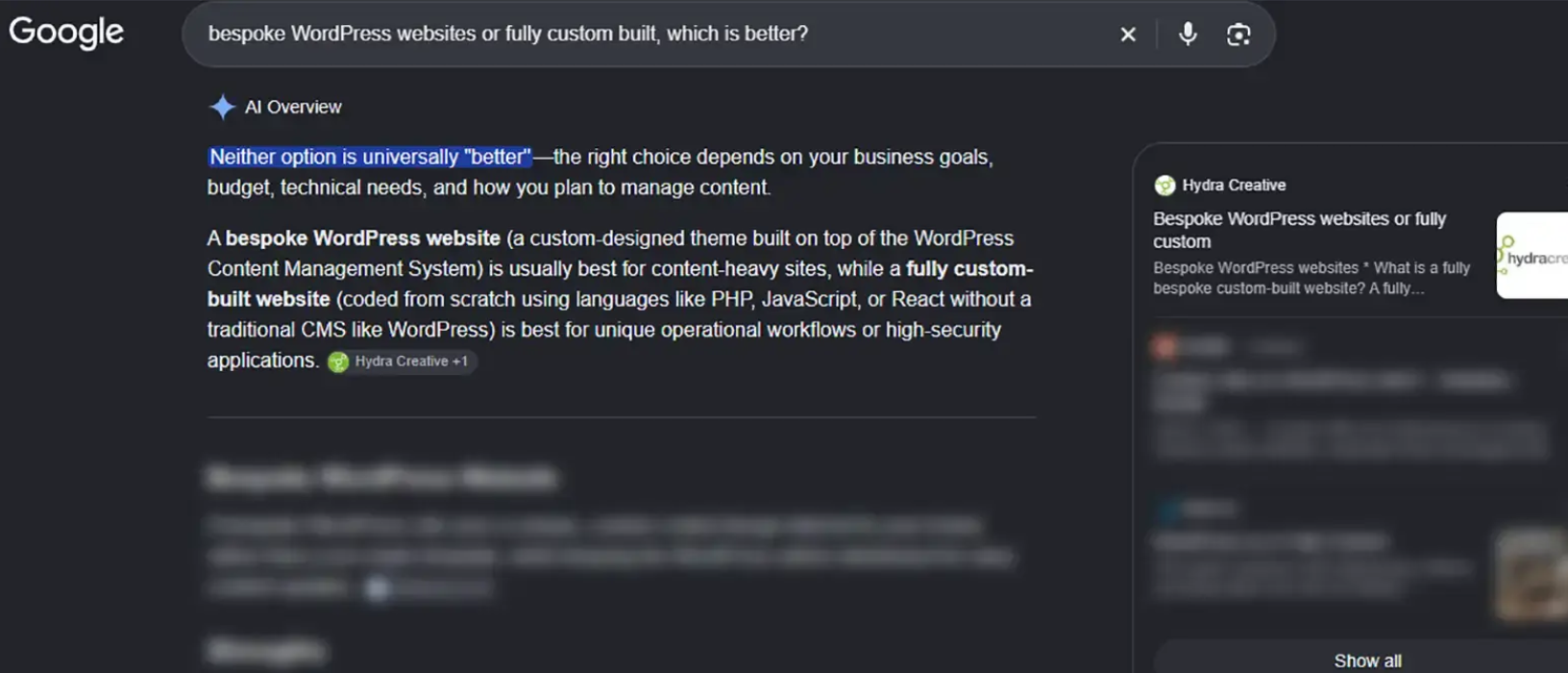
Search is becoming more conversational
Another significant change is the way people are searching. Traditional searches tended to be relatively short and keyword focused. More and more, we see that users are asking longer, more detailed and conversional questions.
For example, rather than searching ‘AI SEO services’ a user might ask, ‘How can I make sure my business appears in AI-generated search results?’
This is a very different type of search.
It gives Google’s AI systems more context about what the user wants, and allows the search experience to move beyond matching keywords. Users can also ask follow-up questions within the AI-generated answers, refining their search without returning to the traditional search results. This translates into a search journey that is more like a conversation or research process than a series of searches and website visits.
Prolonged engagement on Google
Historically, Google’s role was to help users find the right webpage to answer their query. The introduction of AI Overviews has drastically changed that process.
The search results page can now provide summaries, comparisons, explanations and recommendations before a user has clicked anywhere. This means that users can spend longer on Google itself, reading an AI-generated answer and scrolling through supporting results, rather than immediately leaving Google for a website. This subsequently creates a new challenge for website owners and digital marketing teams, who are now seeing website visitor numbers drop.
Being visible in search doesn’t necessarily translate into a click the way it once did. That distinction has become more important when looking at SEO performance data.
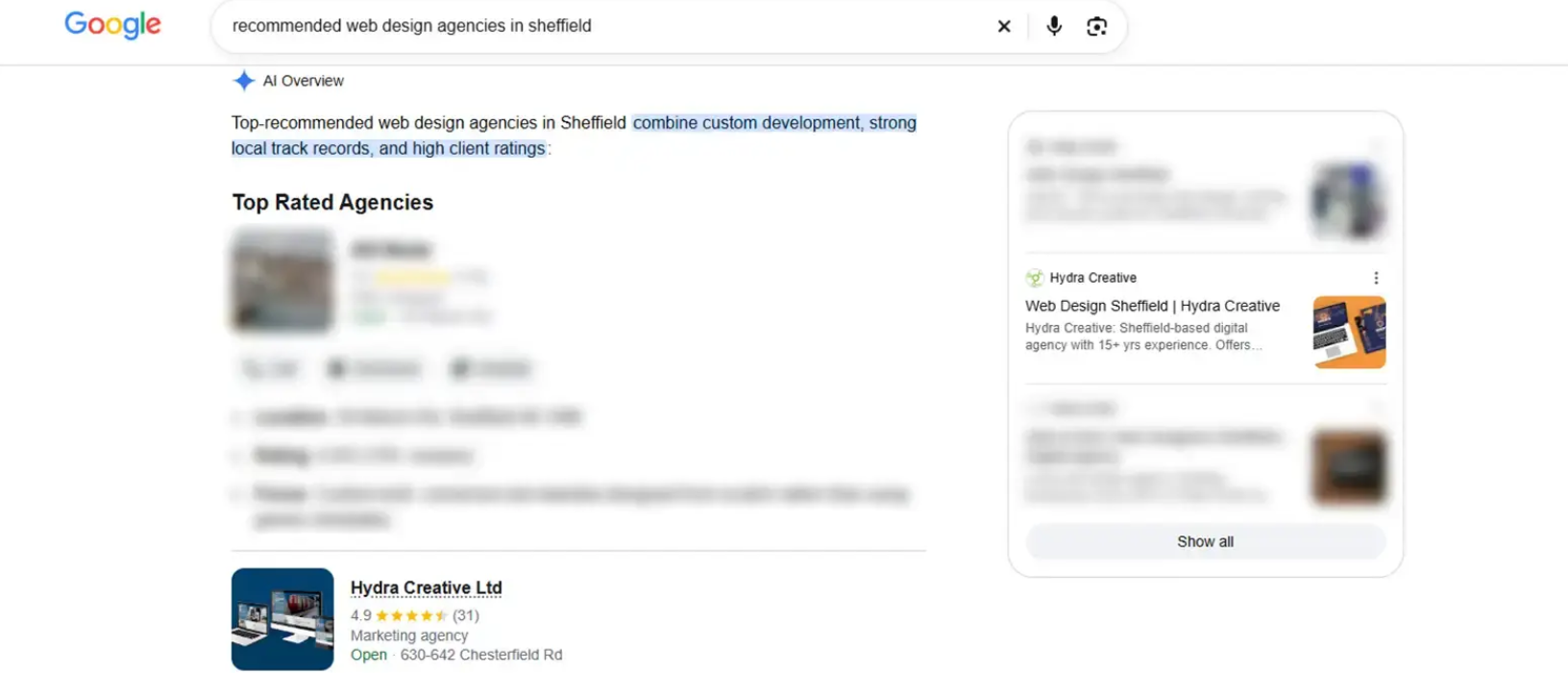
Why else is organic website traffic declining?
AI Overviews aren’t the only factor affecting organic traffic. Search is constantly evolving, and Google’s core algorithm updates can also contribute as broad core updates frequently adjust rankings, favouring sites with specialised expertise.
A combination of factors are currently influencing organic traffic:
- Zero-click searches – Users can find answers without visiting a website, as information that previously required a website visit can now be summarised directly in Google.
- Conversational searches – Users are asking highly specific and complex questions, that work better for websites that have carefully curated content written with these types of questions in mind.
- Changing search journeys – Users can now continue researching within Google’s interface rather than clicking through multiple websites to find answers.
- Changing content expectations – Generic informational content is facing more competition from sources demonstrating genuine expertise and authority.
This means a drop in website traffic shouldn’t automatically be interpreted as a drop in search visibility. If your website is optimised for this new era of search, your audience will still be finding you, but potentially in different ways.
The rise of Generative Engine Optimisation
Generative Engine Optimisation (GEO) is the process of optimising a brand’s online presence so that it has a better chance of being understood, referenced and cited by generative search systems. This includes Google’s AI Overviews, as well as AI platforms like ChatGPT and Gemini. The objective of GEO is not just to rank your webpage at position one of the search results; instead it’s about making sure that when an AI system is answering a question relevant to your business, there is enough reliable and authoritative information about your company and expertise for it to draw upon.
Not every search is being affected in the same way
Someone searching for a specific service is often further along the buying journey and may still need to visit a website to understand the offering, assess credibility, compare providers or make an enquiry.
Local searches can also be more difficult for AI to replace. Whilst AI can easily summarise information available online, it can’t change how close a business is to the person searching. For many local searches, factors such as the user’s location and the business’ proximity remain important to both Google Maps and organic search results.
There is also a limit to how effectively AI can summarise specialist expertise and complex business-specific requirements. This is where businesses have an opportunity. Rather than trying to create more generic content to capture informational traffic, SEO strategies should focus enhancing a website with information that demonstrates genuine expertise, product or service information, and commercial intent.
What can businesses do?
The answer isn’t to abandon SEO just because website traffic is changing. If anything, it means that a well thought out SEO and GEO strategy is even more important to implement into your overall digital marketing plan.
- Make your content easy for AI to understand
Clear, well-structured, and helpful content is important for both users and search engines. Break complex subjects into logical sections, as the easier it is for a search engine or AI system to understand what a page is about, the easier it becomes for that information to be interpreted and potentially surfaced in AI summaries.
- Build genuine authority
Businesses should demonstrate their authority within their sector through expert-led content, case studies, customer reviews and demonstrable experience. The goal is to create content that shows why your business is worth listening to.
- Use structured data markup
Structured data markup can help search engines better understand the information contained on your website. Depending on the business, this could include information relating to services, products, FAQs and locations. This should be viewed as part of a broader approach to making your website - and the information within it - easier for search engines to interpret.
- Measure more than traffic
Website traffic remains important, but it shouldn’t be the only metric by which to measure your SEO performance. Businesses should also be looking at:
- Search impressions
- Rankings and visibility
- Organic enquiries and conversions
- Website engagement
- Changes in search behaviour
- And increasingly, visibility within AI-generated search experiences
A reduction in website clicks doesn’t necessarily mean that your SEO has stopped working. It may indicate that the relationship between visibility and the website visit has changed.
The future of search
The way people are finding what they’re looking for online is changing. As AI becomes more integrated into the search experience, success is increasingly about more than ranking highly in traditional search results. Businesses need to consider how they can remain visible across a search journey that may include AI-generated answers, traditional organic results and local search.
At Hydra Creative, a digital marketing agency, we’re seeing these changes at the coal face, and are adapting our clients’ SEO strategies accordingly. This means combining traditional SEO with approaches designed for the growing world of AI search and Generative Engine Optimisation, in order to achieve success for our clients and their businesses.
If you’re looking to understand how AI search could be affecting your website and what a GEO strategy could look like for your business, contact our team of AI SEO experts for an initial consultation.